Home » Background » About The Bridge
About The Bridge
A Tale of Two Bridges
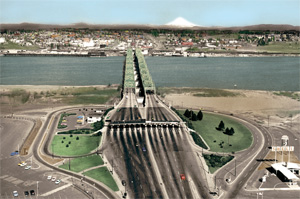
The Interstate Bridge is actually made up of two side-by-side bridges. The northbound bridge was built in 1917 and the southbound
bridge in 1958.
The 1917 Bridge: Shift from Ferry to Bridge Travel
In 1905, the first world’s fair to be held in the Pacific Northwest
opened in Portland, Oregon. The event was a promotional boon to the
Vancouver/Portland area but caused a massive traffic jam at the Columbia
River steam ferry, one of the few passageways between the two cities. This
sparked widespread demand for a bridge between the two states. In 1914, with
a great deal of bi-state local support, the Washington and Oregon state
legislatures approved the sale of bonds to fund such a bridge.
The new bridge opened in 1917 amid much fanfare. It cost travelers 5 cents
to cross. There were only two lanes of traffic, one in each direction.
A streetcar shared the roadway with cars, most of them Model T Fords.
Because the bridge was heavily used, the original bond was paid off within
12 years and tolls removed.
The 1958 Bridge:
The Era of the Automobile
The end of the Vancouver and Portland streetcar service in the 1940s and
increased travel on the bridge prompted Washington and Oregon to look into
increasing the capacity of the bridge. Traffic rates had skyrocketed and it
was time to look for solutions. A dramatic increase in marine traffic also
required more bridge lifts, which made traffic problems even worse.
In 1953, the Washington and Oregon state legislatures authorized the sale of
bonds to design and build a second bridge. Construction of a second parallel
drawbridge was completed in 1958. Tollbooths were installed in 1960 after
remodeling work on the 1917 span had been completed. To pay off the
construction bond, tolls of 20 cents for cars, 40 cents for light trucks,
and 60 cents for heavy trucks and buses were collected until 1966.
Today’s Interstate Bridge: Choices for the Future
The Interstate Bridge has served us well over the last 100 years. But
important choices need to be made about how to meet the next century’s
growing travel needs across the Columbia River.
Today, the Interstate Bridge carries 135,000 vehicles per day. Because
congestion is so heavy in the morning and evening commute hours, bridge
lifts for river traffic have been restricted during the weekday rush hour.
The bridges were built on timber pilings, which still support them today.
Recent geotechnical studies have shown that the soil under the bridges will
likely liquefy to a depth of 75 feet during a significant earthquake. This
could cause severe damage to the bridges.
There are several issues to consider in deciding whether to remove or
reuse the existing bridges:
- Traffic and transit operations and safety
- Navigation operations and safety
- Community and economic impacts
- Natural environment impacts costs
- Other considerations, including ownership