| |
How Does This Project Work?
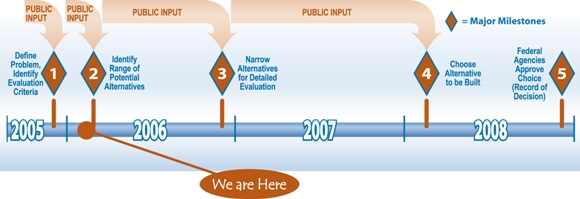
The planning process for the Columbia River Crossing
project is marked by five major milestones:
- Define
the problem and identify criteria for evaluating alternatives
- Identify
the range of alternatives to be
considered
- Identify
alternatives to be considered in
the draft EIS
- Identify
the preferred alternative
- Secure
federal approval for the preferred alternative
Each milestone will build on the previous one and establish the steps needed to arrive at the next step. Many ideas for solutions will be discussed and analyzed during the decision-making process. They will be packaged into alternatives, each including highway, transit, freight, pedestrian, and bicycle elements or "components."
The process leading up to each milestone
will involve study and input focused around four areas: public in volvement,
engineering, environmental analysis, and funding. Each of these
information "streams" will funnel information into the milestones.
By integrating all four areas, we plan to develop a "context
sensitive solution" that is safe, financially feasible, reflects
community values, and is sensitive to environmental impacts.
Steps in the Process
|
Public involvement efforts will be ongoing throughout the project. The community may provide input directly
on the Contact Us page. Public comments will also be sought at open houses and other meetings, as well as through online surveys.
|

|
The Project Team will examine the current transportation problems. As the project progresses, they will develop alternatives for consideration by the Columbia River Crossing Task Force and the public.
|
|
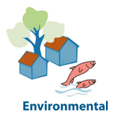
Throughout the project, the Project Team
will gather and analyze information on the existing natural
and community resources in the project area. They will also
evaluate the impacts and benefits of the proposed alternatives.
|
|
Funding experts will consider options for funding the proposed alternatives. These funding options will be refined throughout the project.
|
back to top
|




